This Isn’t Hypothetical Anymore
Last summer, more than 50 cities across North America activated formal heat emergency protocols for the first time in their histories. That’s not a projection or a worst-case scenario. That’s what actually happened. Last year.
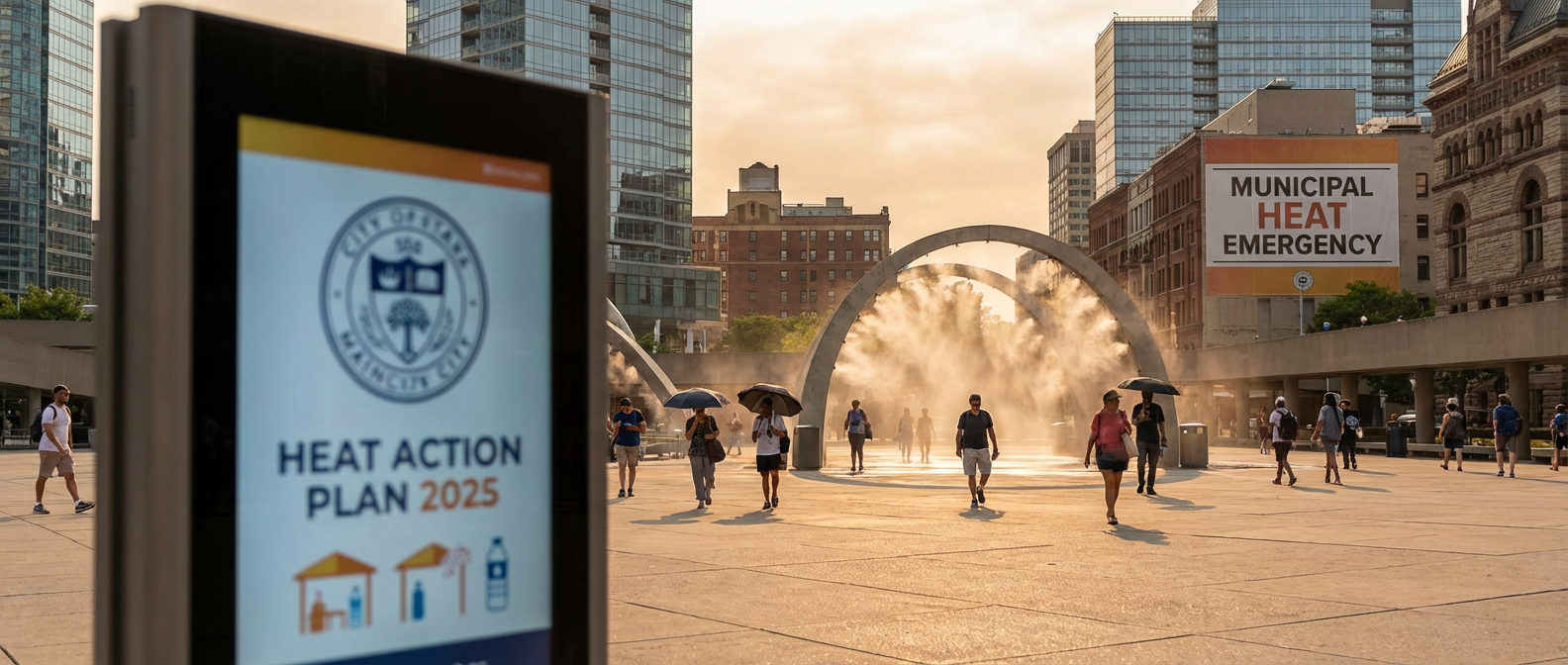
The numbers are stark. NOAA confirmed 2024 as the hottest year on record globally, and their March 2025 seasonal outlook projects above-normal summer temperatures for roughly 70% of the continental U.S. That’s not doom-scrolling. That’s the federal climate data center laying out what’s coming.
What this means for you: Your city probably has a heat action plan now, or it’s scrambling to finalize one. But here’s the thing nobody tells you. Most people don’t actually know what their city promised to do when heat becomes an emergency. And if you don’t know what’s supposed to happen, you can’t hold anyone accountable when it doesn’t.

What the Data Actually Says About Heat in Cities
Emergency room doctors have been noticing something serious. Heat-related visits to emergency departments jumped 32% nationally between 2019 and 2024 according to CDC Environmental Health Tracking Network data. That’s not a gradual trend. That’s a steep climb in just five years.
But here’s where it gets unfair. Your neighborhood probably isn’t as hot as downtown. Urban heat islands are real physics, not metaphor. City centers can run 7 degrees Fahrenheit hotter than the suburbs just a few miles away because of asphalt, concrete, and fewer trees. The poorest neighborhoods in most cities are also the hottest neighborhoods. This isn’t coincidence. It’s history baked into zoning maps.
That’s why the CDC data matters more than the headline temperature. The people most at risk aren’t evenly distributed. They’re concentrated in specific ZIP codes. And that’s exactly what your city’s heat action plan should address.
The Phoenix Model and What Other Cities Are Actually Doing
If your city’s heat plan got any media coverage, it probably referenced Phoenix. For good reason. Phoenix expanded its Heat Relief Network in 2025 and opened 79 cooling centers that handled over 600,000 visitor contacts during summer months, according to Maricopa County public health reports. That’s not just opening buildings. That’s creating accessible infrastructure.
But Phoenix also had the advantage of being forced to think seriously about heat for decades. Most cities are newer to this, which means you’re about to watch best practices get copied, sometimes well and sometimes badly.
Here’s what a real heat action plan promises to do: identify vulnerable populations and the neighborhoods they live in; ensure cooling centers are accessible by transit, have extended hours, and don’t require ID or residency proof; create an emergency alert system that reaches people without smartphones or internet access; set up wellness checks for elderly and disabled residents; and establish protocols for when power fails or grid demand spikes. Most plans miss at least one of these pieces.
Check your city’s plan. Find the actual document. See which pieces are there and which ones got quietly skipped or promised for “later years” of implementation.
The Green Infrastructure Thing Actually Works (And It’s Not Tree-Hugging)
A 2025 Urban Land Institute study found something that should matter to city planners and taxpayers alike. Trees and green infrastructure reduce surface temperatures by 2 to 9 degrees Fahrenheit. Cities with 30% or more tree canopy cover had 19% fewer heat-related hospitalizations per capita. That’s not a nice side benefit. That’s a measurable public health outcome.
Which is why tree planting shouldn’t be treated as optional civic virtue signaling. It’s infrastructure investment. It belongs in the same budget category as streets and water systems.
Most cities’ heat action plans mention trees somewhere. Count how specific they are. Do they commit to actual numbers? Actual neighborhoods? Actual timelines? Or does it say something vague like “increase urban canopy where feasible.” Feasible is a weasel word that means nothing.
This is also where funding becomes crucial, and funding is currently uncertain. The EPA’s Environmental Justice Collaborative Problem-Solving grants, totaling $50 million distributed in 2024 for urban heat mitigation projects, were placed under federal review in early 2025. According to the Environmental Defense Fund’s federal budget tracker, 34 city projects now sit in limbo. Your city might be one of them.
What You Can Actually Do This Week
Get your city’s heat action plan. It’s a public document. Email your city clerk or go to the municipal website. Actually read it. Spend an hour with it. You don’t need a PhD in public health.
Look for three things. First, which neighborhoods are identified as high-risk? Is yours listed? Second, what are the specific cooling center locations and their hours? Write them down. Give them to a neighbor who doesn’t have a smartphone. Third, what’s the alert system? How does it work? Can you sign up?
Then ask your city council member or local representative one direct question: What happens if the power grid fails during a heat emergency? If they don’t have a clear answer, that’s a gap you found. That’s actually useful.
Extreme heat is now an official emergency in most cities, which means your city has made promises. The real question is whether those promises are specific enough to keep, fair enough to matter for the neighborhoods that need it most, and funded well enough to survive political budget cycles. You can find the answer yourself. And you can ask the people who are supposed to deliver on those promises to actually do it.